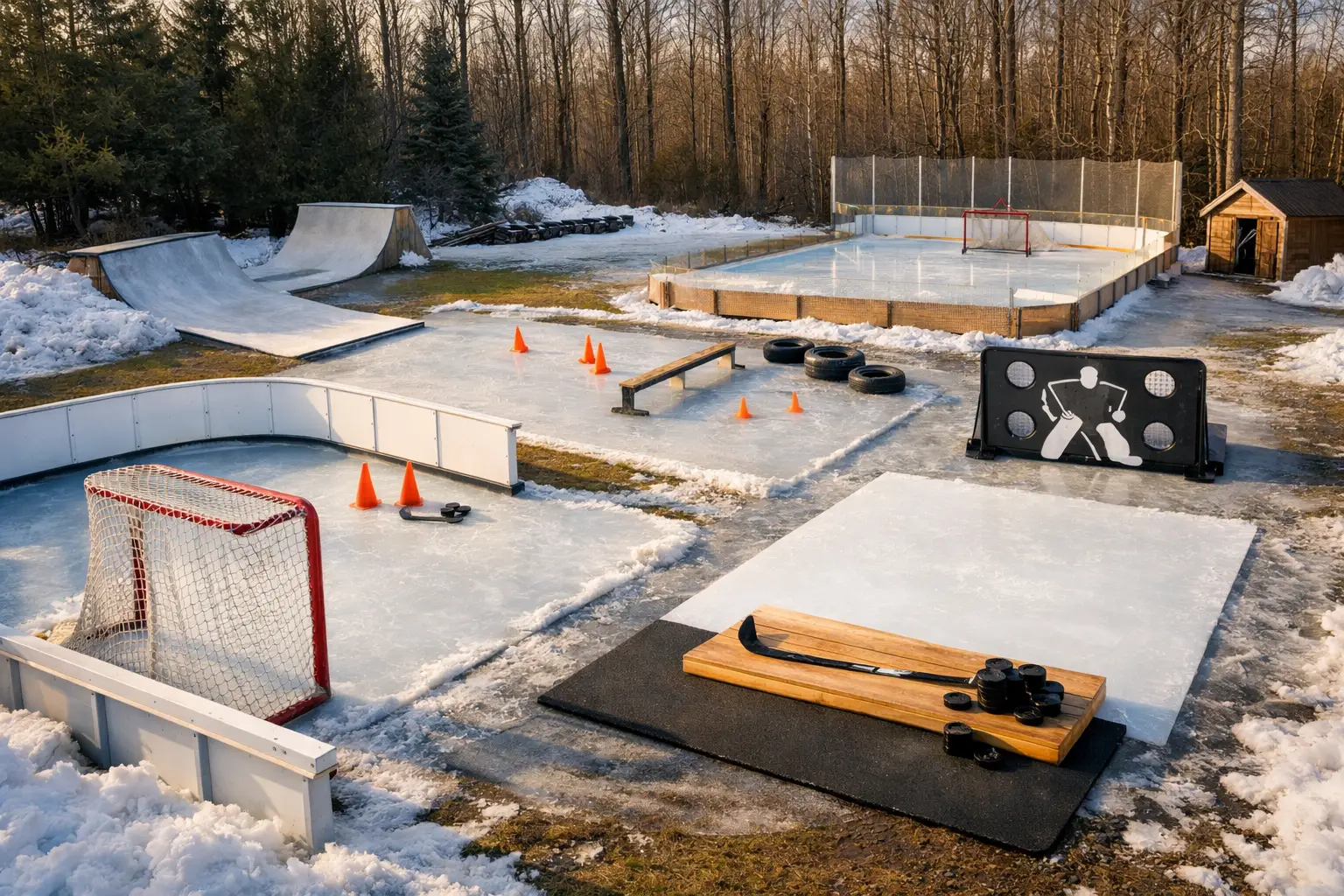
7 Best Backyard Skating Layouts for Training
A backyard rink earns its value in repetitions, not square footage alone. The best backyard skating layouts match the way your household actually skates: a hockey player working on puck control, a goalie building crease movement, a figure skater refining edges, or a family that wants dependable year-round fun. Start with the session you want to create, then build the surface around it.
Synthetic ice gives homeowners a major advantage over seasonal outdoor ice: the rink can stay in place through every month of the year. But panel quality, site preparation, and layout choices still determine whether that advantage feels like serious training time or a surface that rarely gets used.
Start With the Skating Goal, Not the Available Space
The biggest open section of yard is not automatically the right location. A long, narrow footprint may be ideal for stride work and shooting. A compact square can create a high-repetition stickhandling station. A wider rectangular pad gives figure skaters and families more room to move without constantly stopping or turning.
Before choosing dimensions, think about traffic. Who will skate at the same time? Will pucks be used? Is the rink a daily skills station, a weekend family feature, or both? A hockey-focused layout needs safe shooting direction and perimeter protection. A multipurpose rink needs enough open center space for skaters at different levels.
Site conditions matter just as much. Choose a stable area with practical access from the house, garage, or equipment storage. A level, well-supported base protects panel connections and helps preserve a consistent skating feel. Avoid placing the rink where standing water collects, tree debris constantly falls, or a steep slope turns installation into a costly correction project.
7 Best Backyard Skating Layouts
1. The 12-by-12 Skills Square
For younger players, limited yards, or homeowners who want maximum repetition from a minimal footprint, a 12-by-12-foot square is a smart starting point. It is large enough for stickhandling patterns, puck movement, quick feet, balance drills, passing against a rebounder, and basic figure-skating edge work.
This layout is not built for full-speed skating. That is the trade-off. Its strength is efficiency: an athlete can step outside, skate for 20 focused minutes, and complete hundreds of puck touches without traveling to a rink. Put boards or netting on the shooting side if pucks are involved, and leave a clear approach path so players do not step directly from grass or gravel onto the panels.
2. The 10-by-20 Shooting Lane
A shooting lane is one of the best backyard skating layouts for a hockey player who needs more than a driveway shooting pad. The long rectangle supports puck control while moving, shooting in stride, passing drills, and controlled acceleration work. It also fits naturally along the side of a home, fence line, or detached garage where a full rink would not.
Set the goal at one end, with adequate puck containment behind it. A lane is especially effective for players who already have on-ice team practices but need frequent off-ice work on release speed, shooting accuracy, and hands. It is less useful for wide turns, crossovers, or family skating, so do not force it into a multipurpose role it cannot serve.
3. The 20-by-20 All-Around Training Pad
A 20-by-20-foot pad is the most versatile choice for many hockey families. It provides enough space for small-area skating, figure-eight patterns, agility drills, passing, stickhandling, and shooting. Two younger skaters can use it together without feeling boxed in, while one serious athlete has room to create challenging movement patterns.
The square shape makes this layout easier to position in a typical backyard than a longer rink. It also keeps installation costs controlled while delivering a meaningful training surface. If your priority is getting better, faster through frequent skating rather than simulating a full rink, this is often the highest-value home configuration.
4. The 20-by-30 Hockey Development Rink
When skill development is the central goal, 20 by 30 feet is a powerful backyard format. The extra length creates more realistic skating entries into shooting drills, allows players to build speed before handling the puck, and gives coaches or parents space to set up cones, passers, and targets.
This layout works well for a hockey household with multiple players. One athlete can work from the goal line to the blue-line area while another uses the opposite end for hands or passing. Add boards along the long sides if you want a more rink-like experience, but recognize that boards increase the footprint, planning requirements, and budget. For open-yard installations, perimeter netting can be a practical alternative.
5. The Goalie Crease and T-Push Zone
Goalies do not need a giant rink to make serious gains. A 12-by-16-foot or 16-by-16-foot pad with a marked crease is designed for the movements that decide saves: T-pushes, shuffles, recoveries, butterfly slides, post integration, and controlled lateral movement.
The key is to leave enough space beyond the crease for recovery patterns and shooting angles. If a shooter will train with the goalie, add protection behind the net and make sure the shot path is safely contained. A dedicated goalie zone can be installed beside a larger shooter’s pad, giving both athletes a purposeful station instead of asking them to compete for the same small surface.
6. The 16-by-24 Figure Skating Practice Rectangle
Figure skaters need clean, predictable space for edges, turns, spirals, footwork sequences, and off-ice choreography transitions. A 16-by-24-foot rectangle gives enough length for flowing patterns while staying manageable in a residential setting.
Keep this layout open. Hockey goals, shooting targets, and loose training gear break the line of travel and reduce its usefulness. A clear perimeter is more valuable than extra obstacles. For households with both hockey and figure skaters, consider removable equipment rather than permanently dedicating the rink to one sport.
7. The 24-by-36 Family and Multi-Skater Rink
A 24-by-36-foot rink is for families who want the backyard to become a real skating destination. This footprint supports casual skating, hockey drills, beginner lessons, games, and small group sessions. It has enough room for different ability levels, which means it is more likely to stay active after the initial excitement of installation.
This is also the layout where surface performance becomes especially visible. Larger rinks expose weak connections, uneven bases, and low-quality panels quickly because skaters cover more distance and use the space harder. A premium synthetic surface with low friction, strong panel stability, and dependable connections protects the experience over time. SmartRink systems are engineered for homeowners and training environments that expect serious use, not occasional novelty skating.
Build the Layout Around a Reliable Base
Even the right dimensions cannot compensate for poor preparation. Synthetic ice should sit on a firm, level, smooth foundation. Concrete is often preferred for permanent installations because it is durable and stable. Properly prepared asphalt, patio surfaces, and other hard, flat bases can also work when their condition supports the panels evenly.
Check the base with a long straightedge, not just a quick visual inspection. Small variations can become noticeable under skate blades, particularly during turns and crossovers. Plan drainage around the rink rather than through it. Water, dirt, leaves, and grit do not improve the skating experience, and keeping contamination off the surface reduces cleaning time.
Leave room around the perimeter for access and maintenance. You need space to clean the panels, retrieve pucks, inspect connections, and safely enter or exit the rink. For shooting setups, also account for the true path of missed pucks, not only the goal itself.
Choose Surface Performance Over Cheap Square Footage
A larger low-grade rink can be less useful than a smaller, high-performance surface. Skaters feel the difference in glide, stopping response, and the consistency of every stride. Material formulation and manufacturing method matter because they affect friction, wear resistance, and how the rink performs after thousands of training reps.
Look for sinter-pressed, high molecular weight resin panels rather than treating all synthetic ice as interchangeable. Strong connection systems are equally important. They keep the surface aligned under active use and make installation more predictable, especially on larger layouts. The goal is not simply to own a rink. The goal is to create a place where athletes want to train because skating feels close enough to real ice to make every session count.
The right backyard layout should make practice easier to start. When skates, sticks, and a high-quality surface are only steps from the back door, the next edge drill, shooting session, or family lap no longer depends on rink schedules.


Comments